10/27/2026
October 26, 1942
Guadalcanal Day Fourteen
By the morning of October 26, 1942, the soldiers of North Dakota's 164th Infantry Regiment had endured several nights of some of the fiercest fighting of the Guadalcanal Campaign.
At Coffin Corner, J*panese soldiers continued moving through the jungle in front of Companies E and L. Snipers and machine gunners harassed American positions, while enemy infantry gathered in the tall grass and brush. Occasionally, American soldiers could see the tips of J*panese bayonets moving above the vegetation.
Marine artillery and Army mortars pounded J*panese positions along the jungle's edge. Some shells fell dangerously short, exploding near American bunkers. One shell wounded Porter, while another showered Cecil with dirt and fragments, embedding a piece of shrapnel in his r***e stock.
A Marine artillery forward observer joined Lang and Hanson in their bunker to adjust the supporting fire. Determined to bring the shells as close as possible to the J*panese positions, he [Marine FO] instructed his fire direction center, "Bring the rounds in another ten yards and we'll scratch our names on them as they go by." For the exhausted soldiers of Company E, it was a reminder that danger could come from either direction.
The struggle to maintain the defensive line continued.
A shortage of 60mm mortar am******on temporarily silenced Company E's mortars for several hours. Supplies eventually arrived by air, allowing the crews to resume operations before nightfall.
Meanwhile, soldiers repaired bunkers, strengthened barbed-wire obstacles, cleaned their weapons, and replenished am******on. Their meals consisted largely of C rations, water, and D ration chocolate bars.
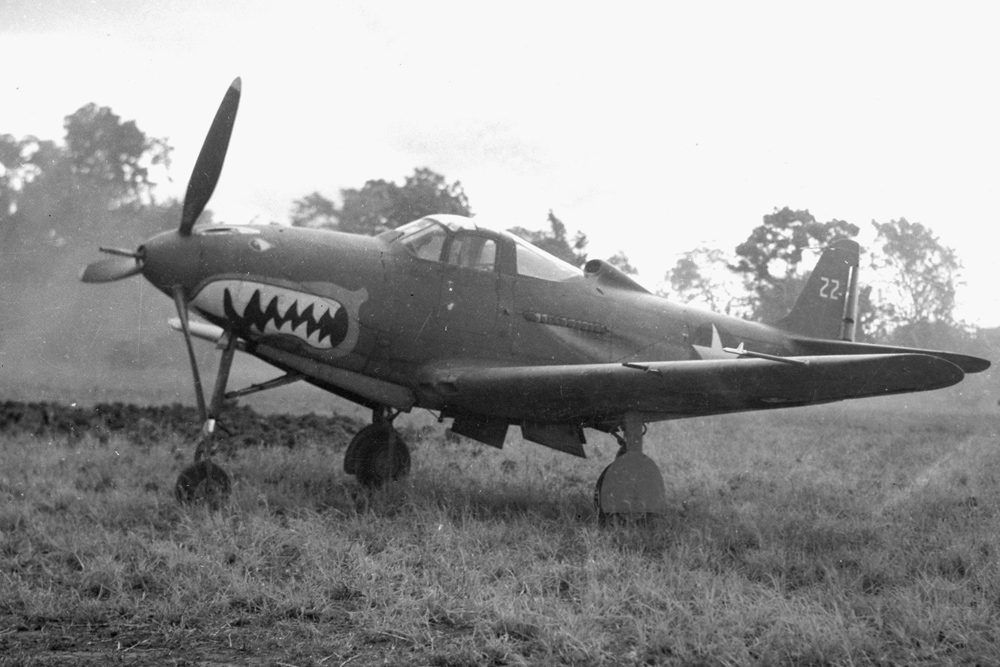
Above the battlefield, two Army P-39 Airacobras, nicknamed "Pete" and "Repeat," made low-level strafing runs against J*panese positions near Coffin Corner and Grassy Knoll. Their machine guns, 37mm cannons, and antipersonnel bombs struck the jungle's edge, igniting a grass fire in the Bowling Alley. Overhead, Marine Wildcats battled J*panese Zero fighters, while J*panese aircraft continued bombing and strafing the American perimeter.
Farther out at sea, the Battle of the Santa Cruz Islands unfolded. The aircraft carrier USS Hornet was sunk, and USS Enterprise was damaged. Although both sides suffered serious losses, the J*panese fleet ultimately withdrew without providing the support its ground forces desperately needed.
As darkness approached, the 164th prepared for another J*panese assault.
Shortly before nightfall, Heffernan and a small group of soldiers from the 3rd Battalion established a listening post approximately 400 yards forward of Coffin Corner. Using an EE-8 field telephone, they reported J*panese movements to battalion headquarters.
When the J*panese discovered the listening post and advanced against it, the Americans were forced to withdraw. Despite becoming separated in the darkness, every member of the patrol made it safely back to friendly lines.
Soon, J*panese infantry again attacked the positions of Company E and the 3rd Battalion.
One J*panese soldier approached the American line carrying a flamethrower. American fire apparently struck the fuel tank, engulfing the soldier in flames. The burning fuel briefly illuminated the surrounding jungle, exposing other advancing J*panese troops to American machine-gun and r***e fire.
The J*panese pressed forward in groups, supported by mortars and machine guns.
But once again, the 164th Infantry held. As the Company E historical account records, "They could not pe*****te or force back the line of the 164th Infantry."
Company E and the 3rd Battalion maintained their positions without requesting reinforcements. J*panese casualties continued to mount in front of the American barbed wire.
J*panese infiltrators remained active behind American positions, moving through the darkness in small groups. Around 3:00 a.m., a guard near Stannard's bunker encountered an approaching figure along the Back Trail. When the figure failed to respond to his challenge, the guard opened fire with his Thompson submachine gun.
The intruder was a J*panese soldier carrying two empty canteens, apparently attempting to obtain water from an American lister bag only a few yards behind the platoon command post. It was a chilling reminder of just how thoroughly the J*panese had infiltrated the American perimeter.
By daylight, General Maruyama's offensive had again failed.
His Sendai Division had suffered heavy casualties, am******on supplies were dwindling, and wounded J*panese soldiers lacked adequate medical care.
Despite these setbacks, Maruyama remained determined to attack again. He withdrew his main forces to reorganize, leaving infantry and machine gunners forward to continue harassing the American defenders.
He believed that another night of fighting might finally break the exhausted Americans and open the way to Henderson Field.
But the North Dakotans had already demonstrated something extraordinary.
The men of the 164th Infantry Regiment, fighting alongside their Marine comrades, had helped defeat repeated J*panese assaults during one of the most critical battles of the Guadalcanal Campaign.
Their determination helped keep Henderson Field in American hands.
Source: Source: John E. Stannard, "Battle of Coffin Corner," pp. 88-91, October 26, 1942.
Image: "P-39 Airacobra," and "Soldiers on Guadalcanal," Several unidentified soldiers on Guadalcanal. This photograph was taken by Colonel Art Timboe. A native of Devils Lake, North Dakota, Colonel Arthur Timboe (1907-1996) served in the 164th Infantry Regiment in World War II and as a Public Information Officer for the Korean Communication Zone during the Korean War. Elwyn B. Robinson Department of Special Collections, Chester Fritz Library, University of North Dakota